You don’t know this language. Which crate will you open?
Nobody speaks this language. By the third crate, you’ll be reading a whole sentence in it.
A warehouse where everything is labelled
We made this language up for this page. It isn’t in any textbook or translation app, and nobody speaks it aloud. One person writes it, though: the storekeeper, who has labelled his entire warehouse in it.
You need to open three crates. Nobody will hand you a dictionary, but a few things are already open and labelled. Compare the labels, rule things out, choose. A wrong guess costs nothing — you can always choose again.
House rules
There are three, and they guarantee that every task has exactly one answer — one you can prove rather than guess. Living languages make no such promises; more on that at the end.
- A word always means the same thing, and nothing has two names.
- Every word names something you can see in the picture: a thing, its colour, or where it stands — and where the word sits in a label or note always tells you which of the three.
- Nothing here lies: a crate’s label lists everything inside it, and a note always points to exactly one thing.
Crate one: the yellow key
The storekeeper wants the yellow key. Along the top are three open crates: you can see both what’s inside and what the label says. Below are three closed ones. Blue things in the pictures have white dots.
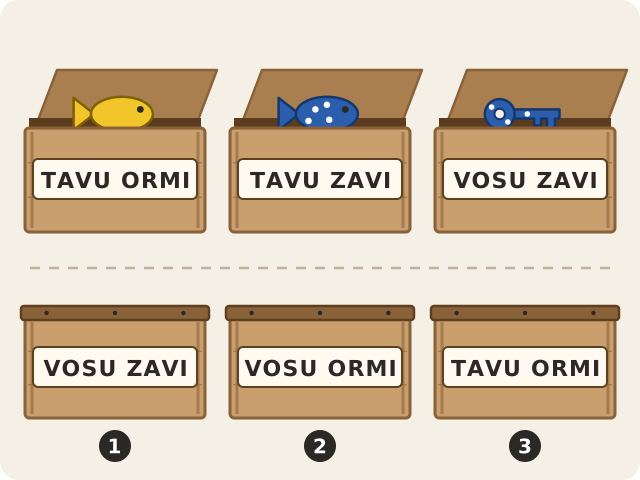
Crate one: your pick
The task: find the closed crate with the yellow key. Work it out from the picture above, then check yourself against the explanations for all three options.
Answers and explanations
- Crate 1 — VOSU ZAVI: Wrong crate. There is a key in it, but a blue one: ZAVI is also on the crate with the blue fish.
- Crate 2 — VOSU ORMI: Right crate. TAVU is on both fish crates, so TAVU is the fish and the second word is the colour: ORMI is yellow, ZAVI is blue. That leaves VOSU on the blue-key crate: VOSU is the key. A yellow key is VOSU ORMI — a label no open crate showed you.
- Crate 3 — TAVU ORMI: Wrong crate. What’s inside is yellow, but it’s a fish: the open crate with the yellow fish has exactly this label.
Crate two: the note
The storekeeper doesn’t do talking; he writes notes. Each one points to a single thing. Two old notes survive, each with a tick over the thing he meant, and they contain new words. The third note is for you.
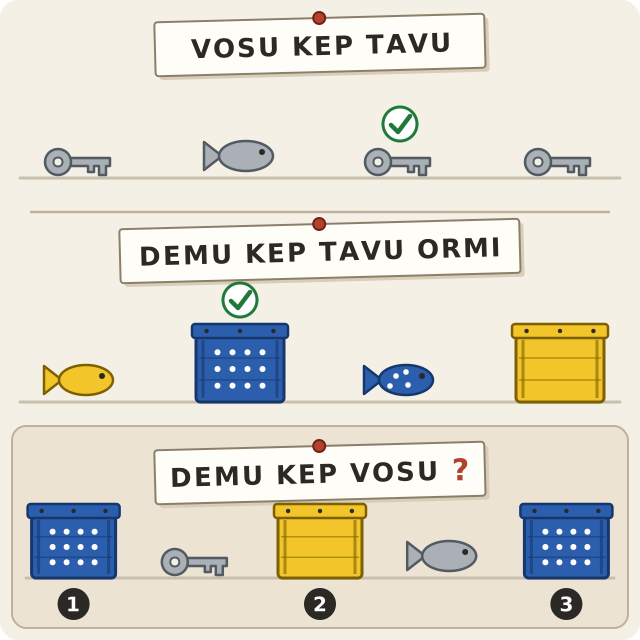
Crate two: your pick
The task: work out which crate today’s note, DEMU KEP VOSU, points to. Decode the two old notes first, then check yourself against the explanations.
Answers and explanations
- Crate 1: Wrong crate. It stands to the left of the key. That’s how it looks if you read the note like a picture, left to right — but in both old notes the ticked thing stands to the right of the other thing named.
- Crate 2: Right crate. In the first old note you already know both things — VOSU, the key, and TAVU, the fish — and the tick is on the key immediately to the right of the fish, not the far one and not the left one. So KEP means ‘stands immediately to the right of’. In the second note TAVU ORMI is the yellow fish, just like the label in round one, and the tick is on the crate immediately to its right: DEMU is a crate. DEMU KEP VOSU is the crate immediately to the right of the key.
- Crate 3: Wrong crate. It stands immediately to the right of the fish — the note for that one would say DEMU KEP TAVU. It’s also the rightmost crate, but in the first old note the ticked key wasn’t the rightmost one.
Crate three: the last note
The last note is waiting by a new row. The row is longer, and so is the note. The house rules still apply.
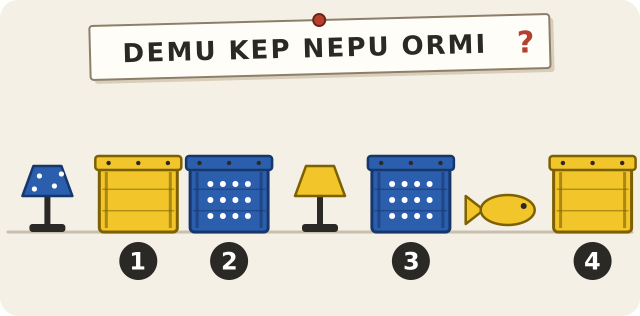
Crate three: your pick
The task: find the crate that the note DEMU KEP NEPU ORMI points to. Work it out from the picture above, then check yourself against the explanations.
Answers and explanations
- Crate 1: Wrong crate. It’s yellow and stands immediately to the right of a lamp — but that lamp is blue. ORMI comes after NEPU, and in this language a colour follows its own thing: in the second old note TAVU ORMI was the yellow fish. So the yellow thing here is whatever NEPU names, not the crate.
- Crate 2: Wrong crate. It stands immediately to the left of the yellow lamp, and KEP means ‘immediately to the right of’.
- Crate 3: Right crate. NEPU wasn’t on any crate or in any note. But it sits where notes always put a thing, and it can’t be the fish, the key or the crate: they already have names, and nothing here has two. The only unnamed things left in the picture are the lamps. So NEPU is a lamp, NEPU ORMI is the yellow lamp, and you want the crate immediately to its right. Inside is a dictionary of this language. It has seven words, and you already know all seven.
- Crate 4: Wrong crate. It stands immediately to the right of the yellow fish, but the fish is TAVU, and nothing has two names.
Why there was only one answer
A handful of examples never proves what a word means — in any language. Each answer here was the only one because of the three house rules. Drop any of them and the same pictures allow other readings.
Without the first rule, NEPU could have been a second word for fish, and the crate after the fish would fit. Without the third, KEP could mean just ‘somewhere to the right’, and two keys would fit the first old note.
And the colours? We only ever showed one blue. A Russian speaker would ask straight away whether ZAVI means синий, dark blue, or covers голубой, light blue, as well: Russian makes an obligatory distinction between the two, while English gets by with a single ‘blue’. To find out, you’d need a light-blue crate — with an honest label.
A living language offers no such guarantees. It has synonyms, words with several meanings and exceptions, so every guess gets tested on new texts, again and again.
How it went for real
That is roughly how Linear B was read in the middle of the twentieth century — the script on clay tablets from Crete and mainland Greece. In the late 1940s Alice Kober noticed groups of words that differed by a single sign and used them to prove that its words changed their endings. At the time nobody knew how a single sign was pronounced.
Michael Ventris extended her grid of signs and tested a hunch about the names of Cretan towns, Amnisos and Knossos. The sound values that filled the grid made many other words on the tablets read as an early form of Greek — not what Ventris himself had expected; he had bet on Etruscan or a relative of it. He announced the decipherment on BBC radio on 1 July 1952.
Striking confirmation came in 1953 from a tablet found at Pylos the year before. Read with Ventris’s values, its words named what was drawn beside them: ti-ri-po-de stood next to tripods, and words that read as ‘four-handled’, ‘three-handled’ and ‘without handles’ stood next to vessels drawn with four handles, three and none. Just like your crates, only real.
The language on this page is made up. The reasoning isn’t: spot a repeat, make a guess, test it on something new.
Sources & further reading
- Faculty of Classics, University of Cambridge: The Decipherment Process (PDF)
- Anna P. Judson, The Undeciphered Signs of Linear B, Cambridge University Press, 2020 — excerpt from chapter 1 (PDF)
- John Chadwick, The Decipherment of Linear B — chapter ‘Decipherment and the critics’, Cambridge University Press
- Winawer J. et al., ‘Russian blues reveal effects of language on color discrimination’, PNAS, 2007 (PubMed)