The dictionary invented a word. By mistake
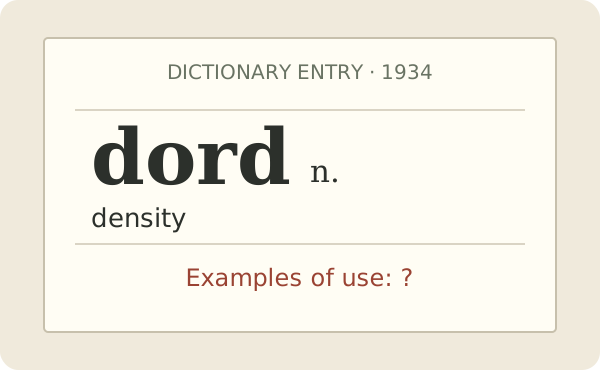
Meet dord: a noun meaning “density.” The entry is already in the dictionary, but examples of the word being used are nowhere to be found. How did it get there?
It looks perfectly respectable
Webster’s New International Dictionary, Second Edition, appeared in 1934. Among its entries was dord, complete with a definition and pronunciation. It had no etymology; the publisher’s files held no examples of use either. Merriam-Webster describes these gaps in its account of the error.
That makes a neat trap for the reader. An unfamiliar word looks exactly as an unfamiliar word ought to look. Finding something you do not already know is the reason you opened a dictionary.
Choose a theory before opening the slip
This is a small investigation, not a vocabulary test. Guess where dord came from; every explanation is available below.
Answers and explanations
- The publisher planted a trap for copyists: That would explain a deliberately invented entry. But the dord records show an error while preparing an ordinary entry, not a secret plan.
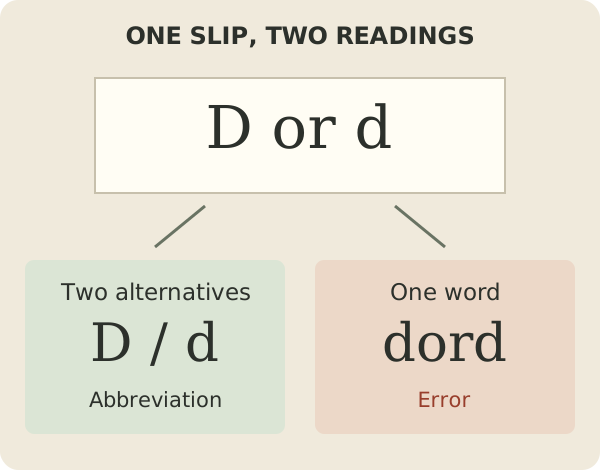
- Two abbreviations were read as one word: Yes: D or d meant capital D or lowercase d. The connecting word or became the middle of a new word.
- It was an obscure laboratory term known only to specialists: The scientific definition and a chemistry editor make that convincing. But the source slip described abbreviations, not the use of a specialist term.
Check the spaces
It began with a slip from chemistry editor Austin M. Patterson: D or d. Capital D or lowercase d could stand for density. A note about an abbreviation was mistaken for an ordinary dictionary entry.
Staff typed spaces between the letters of a headword to leave room for later marks. That allowed D or d to be read as four letters of one word. A pronunciation and a part of speech followed. Editorial polish made the error look more convincing.
Print is not a second witness
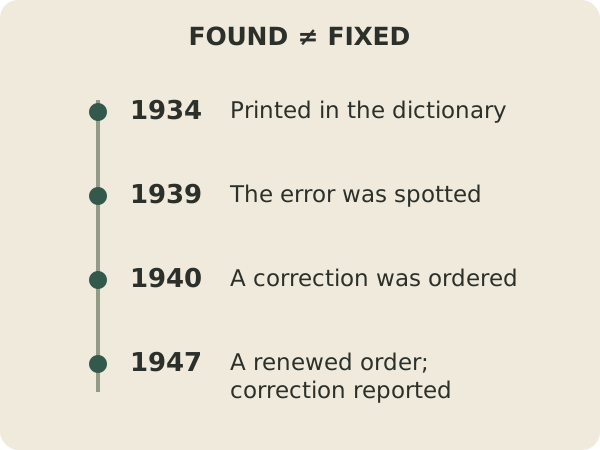
The error was spotted in 1939. In his study of the editorial slips, Allen Walker Read records a plate-correction order in 1940 and a renewed order in 1947. Merriam-Webster also dates the actual correction to 1947. The reason for the delay is unexplained.
The five years from 1934 to 1939 measure the wait for discovery. Finding the mistake and removing it from later printings were separate events.
Put two gaps back
Our diagram needs no replacement letters. Open up the string: D · or · d. The little word or can do its job again, joining two alternatives.
The dictionary’s ghost had a definition, a pronunciation and a biography lasting years. What disappeared was its claim to be an established English word for density. And two missing spaces found their way home.