French « si »: the ticket is here
Alex thinks the ticket is missing. Mina pulls it from her pocket: “Si!” Discover what those two letters correct, then try four replies.
A tiny scene at the station
This is a fictional scene for practising the answer.
The train leaves in five minutes. Mina reaches into her jacket.
“Tu n’as pas ton billet ?” Alex asks. Don’t you have your ticket?
Mina pulls out the ticket.
“Si, j’ai mon billet !” Yes, I do have it!
That tiny si overturns Alex’s assumption. The ticket was there all along.
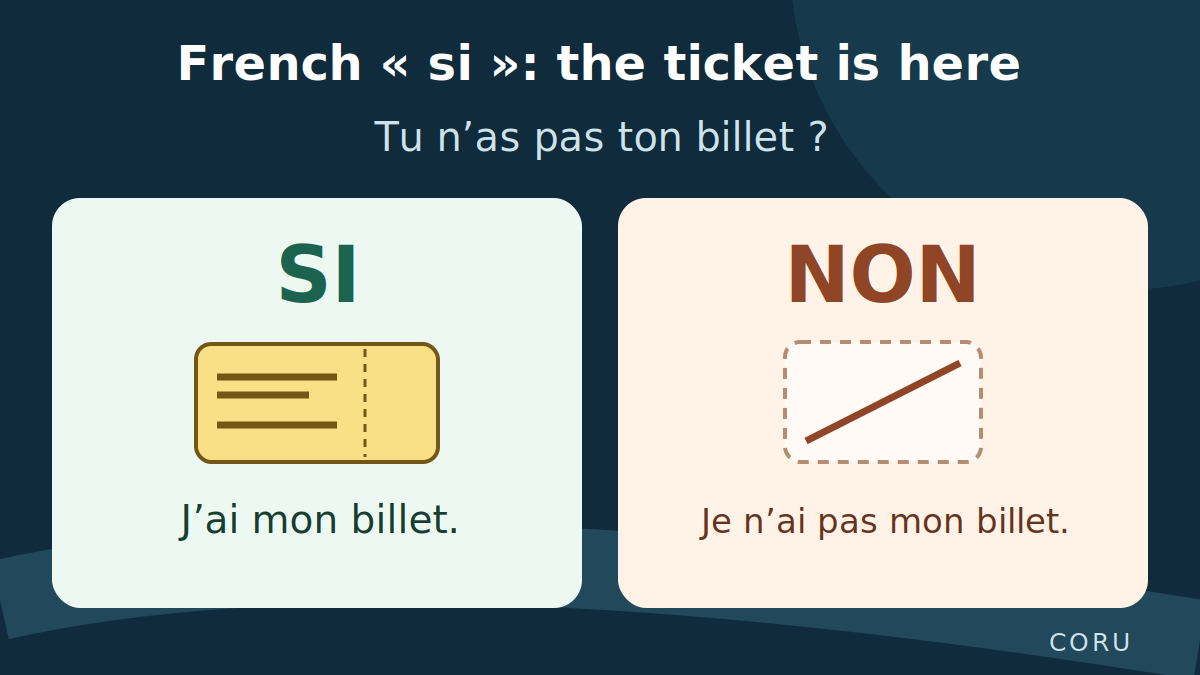
One question, two realities
For “Tu n’as pas ton billet ?”, choose the answer that matches the facts:
- You have the ticket. → Si, j’ai mon billet. Yes, I do.
- You do not have the ticket. → Non, je n’ai pas mon billet. No, I don’t.
What about a positive question?
Now remove the negative from Alex’s question: “Tu as ton billet ?” Do you have your ticket? The positive answer starts with oui: “Oui, j’ai mon billet.”
For these simple questions, use oui for a positive answer to a positive question, si for a positive answer to a negative question, and non for a negative answer. The Académie française’s explanation confirms the two answers to a negative question.
It works without a question mark
Alex could state: “Tu n’as pas ton billet.” You haven’t got your ticket.
Mina can correct him: “Si, il est dans ma poche.” Yes, I have; it’s in my pocket. Si also contradicts a negative statement.
Keep the short sentence after your answer word. “Non, je n’ai pas mon billet” carries more information than a bare “non”. You do not need to solve the conversation with a single syllable.
Your turn to speak
Read each situation. Say your answer aloud before checking below.
- 1. “Tu viens avec nous ?” Are you coming with us? You are coming.
- 2. “Tu ne viens pas avec nous ?” Aren’t you coming with us? You are coming after all.
- 3. “Tu n’as pas ton billet ?” Don’t you have your ticket? You left it at home.
- 4. “Tu n’as pas ta carte.” You haven’t got your card. It is in your bag.
Possible answers
- 1. Oui, je viens avec vous. Yes, I’m coming with you.
- 2. Si, je viens avec vous. Yes, I am coming with you.
- 3. Non, je n’ai pas mon billet. No, I don’t have my ticket.
- 4. Si, elle est dans mon sac. Yes, I have; it’s in my bag.
Change the facts
Try number two again, but this time you are staying home: “Non, je ne viens pas.” Let the facts guide your answer.
Two details worth recognising
In speech, you may hear “Tu as pas ton billet ?” The missing ne does not make it positive. The OQLF explains that ne is often omitted in speech. Our written models keep it.
French writes this si without an accent. In “Si tu viens, prends ton billet” — if you come, take your ticket — si introduces a condition. It has a different job.
These are useful patterns for simple questions, not every possible reply across the French-speaking world. When unsure, state the whole thought: “J’ai mon billet” or “Je n’ai pas mon billet”.